Selected Works
Drift
Drift is an agentic AI workspace designed to make autonomous AI actions feel observable, reversible, and trustworthy.

My Role
UX Designer
Duration
1 month
Responsibilities
User Research, UX Planning,
UI Design and Prototyping
Link
Overview
Most AI agents aren’t failing because they’re incapable. They’re failing because users can’t see what they’re doing.
Today’s AI tools automate tasks, summarize workflows, and take actions in the background, but very few explain why something happened, what the AI changed, or how users can intervene when something feels wrong.
As AI systems become more autonomous, the challenge shifts from capability to trust.
What if AI actions felt observable instead of invisible?
Solution
That became the foundation for Drift.
Not another AI dashboard. A system designed around supervised autonomy.
Drift helps users:
understand what their agents are doing
review actions before they escalate
intervene when needed
gradually increase autonomy over time
Instead of treating AI like magic, Drift treats it like a visible teammate.
The Reality
I started by analyzing how current AI products handle automation and agent-like behavior. Most systems optimized heavily for speed and abstraction, but left users disconnected from the decision-making process.
What I Kept Hearing
Users didn’t necessarily distrust AI outputs, they distrusted not knowing how decisions were made.
“I don’t mind AI helping me. I mind not knowing what it changed.”
“Sometimes automation feels less like assistance and more like losing visibility.”
“I want AI to move fast, but I still want checkpoints.”
The issue wasn’t lack of functionality. It was lack of observability, reversibility, and control.
Target Users
Operations & Finance Teams
Age 28-45
Behaviour Markers
• Manage repetitive operational workflows • Review invoices, approvals, and internal processes • Need visibility before high-stakes actions are executed
Pain Points
AI actions feel difficult to audit
Founders & Small Teams
Age 25-40
Behaviour Markers
• Juggle multiple tools, notifications, and workflows • Depend on automation to reduce manual work • Frequently switch between oversight and execution
Pain Points
Automation systems become difficult to monitor at scale
AI-Forward Teams
Age 22-35
Behaviour Markers
• Automates repetitive workflows • Early adopers of AI copilots and agents • Values speed and efficiency
Pain Points
Existing tools either hide too much or expose too much
Competitive Insights
What Makes Drift Different
Supervised Autonomy, Not Blind Automation
Designed Around Legibility
Built for Recovery & Oversight
Competitors
Notion AI
Notion AI feels collaborative, but not observable.
Linear optimizes clarity of workflow state, but not clarity of AI intent.
Superhuman optimizes for flow-state, sometimes at the cost of AI legibility.
Zapier creates observability for engineers, not confidence for everyday users.
Linear
Superhuman
Zapier
Observation
Key Insights
People don’t distrust AI because it’s incapable.
They distrust what they can’t see.
The core design principle for Drift was simple: autonomous systems should feel observable, interruptible, and accountable, not invisible or unpredictable.
As agents become more capable, trust can’t rely on outputs alone. Users need visibility into actions, reasoning, and recovery paths.
What This Meant In Practice
Agent actions are surfaced chronologically through a visible timeline, not hidden background automation.
Every autonomous action includes context, reasoning, and system status.
Approval checkpoints are introduced for high-stakes or external actions.
Progressive autonomy levels help users gradually build trust over time.
Undo, pause, and recovery flows make the system feel reversible instead of rigid.
The interface prioritizes clarity and calmness over “magical AI” aesthetics.
Product Thinking
Product UI - The Experience
The main design challenge was balancing autonomy with oversight. Most AI systems either expose overwhelming technical logs or hide too much complexity entirely. Drift needed a middle ground.
The solution was layered visibility.
High-level actions remain scannable and lightweight, while deeper reasoning, intervention controls, and recovery states appear contextually when needed. The experience focuses on helping users understand what the system is doing without creating cognitive overload.
Trade Offs: What I Chose Not To Build
No conversational chatbot interface - Drift focuses on observable actions rather than prompt-based interaction.
No fully autonomous default mode - trust is designed to build progressively through supervised autonomy
No dense system logs - surfaced only the information necessary for clarity and intervention
No attempt to humanize AI with personalities or avatars - the product prioritizes accountability over anthropomorphism
Tensions I Navigated
Transparency vs simplicity - resolved through progressive disclosure and layered detail.
Automation vs user control - resolved with adjustable autonomy levels and approval boundaries.
Trust vs cognitive overload - important actions are emphasized while low-risk actions remain lightweight and unobtrusive.

I designed the dashboard as a high-level command center where users can monitor agent activity, pending approvals, and system health at a glance. The goal was to provide awareness without overwhelming users with technical automation details.

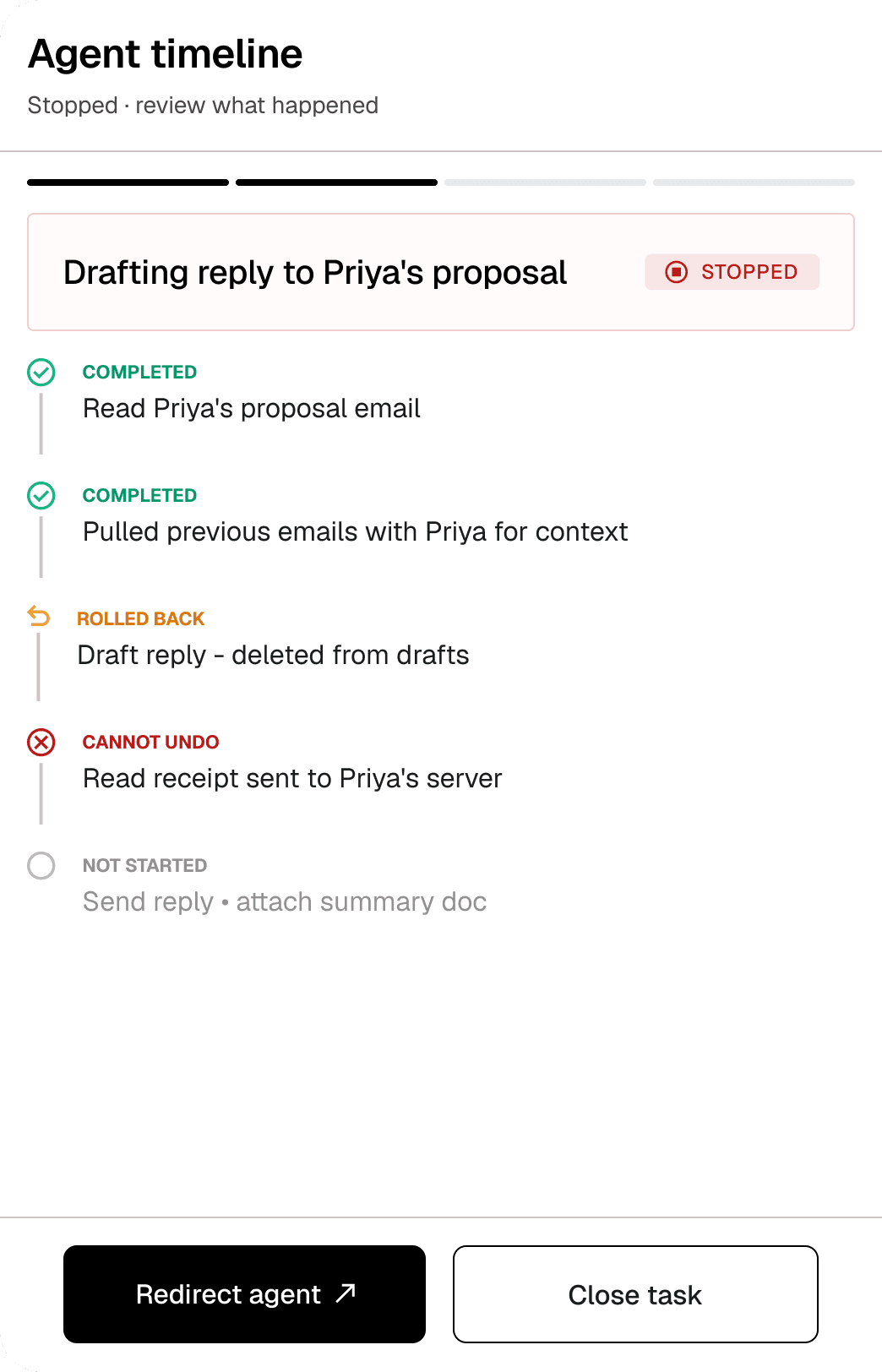
The timeline acts as the system’s source of truth, surfacing every agent action in chronological order. Each entry provides context, reasoning, and status indicators, helping users understand what happened, why it happened, and whether intervention is required.


Agent redirected
Back on track
Agent redirected successfully
Now drafting a casual reply asking Priya for a call first
Drafting casual reply to Priya
ACTIVE
updated goal
Draft casual reply requesting a call · then attach pricing doc · send
Email agent
Redirected by you
Done - close panel
Rather than moving users across multiple screens, I used four slide-out drawers to progressively reveal information. These drawers provide deeper visibility into reasoning, action details, approval workflows, and recovery states while keeping the timeline focused and scannable.

introduced adjustable autonomy levels that allow users to define how much authority each agent has. By moving from Ask first to Full auto, users can gradually build trust and calibrate automation according to task sensitivity.
Design Execution
I designed Drift around visibility rather than automation. Every action the agent takes is surfaced through timelines, approvals, and system states so users never feel disconnected from what’s happening.
The autonomy slider became a core interaction pattern helping users gradually calibrate trust instead of forcing an all-or-nothing automation model.
The interface intentionally avoids dense dashboards and technical logs. Information is progressively layered so users can quickly scan actions first, then inspect reasoning or intervene only when needed.
Color and motion were used semantically to communicate risk, confidence, and action states. High-stakes actions feel visually distinct from low-risk background automation.
The system was designed around reversibility. Undo flows, pause states, and recovery mechanisms were prioritized early to make AI behavior feel accountable instead of irreversible.
Expected User Outcomes
This is a concept product, so there are no live metrics. But the design communicates specific, testable hypotheses:
Expected User Outcomes
<15s
Time to Understand Agent Actions
-35%
Reduction in Cognitive Overload
+50%
Faster Intervention & Recovery
+40%
Improved Perception of AI Transparency
Reflection
What I'd Do Differently
The biggest open question is how much visibility users actually want over time. Early versions exposed more reasoning and system detail, but the experience quickly became cognitively heavy.
If I continued the project, I’d explore adaptive visibility where the system surfaces more or less detail depending on action risk, user familiarity, and confidence levels. Low-risk actions could remain lightweight, while high-stakes actions become increasingly inspectable.
I’d also test whether timelines should prioritize chronological actions or grouped narratives around tasks and outcomes.
What I Learned
Designing agentic systems is less about showcasing AI capability and more about designing trust around uncertainty.
Transparency alone is not enough - visibility has to remain understandable and actionable.
Reversibility is one of the strongest trust-building mechanisms in autonomous systems. Users feel more comfortable with AI when mistakes feel recoverable.


Selected Works
Drift
Drift is an agentic AI workspace designed to make autonomous AI actions feel observable, reversible, and trustworthy.
My Role
UX Designer
Duration
1 month
Responsibilities
User Research, UX Planning,
UI Design and Prototyping
Link
Overview
Most AI agents aren’t failing because they’re incapable. They’re failing because users can’t see what they’re doing.
Today’s AI tools automate tasks, summarize workflows, and take actions in the background, but very few explain why something happened, what the AI changed, or how users can intervene when something feels wrong.
As AI systems become more autonomous, the challenge shifts from capability to trust.
What if AI actions felt observable instead of invisible?
Solution
That became the foundation for Drift.
Not another AI dashboard. A system designed around supervised autonomy.
Drift helps users:
understand what their agents are doing
review actions before they escalate
intervene when needed
gradually increase autonomy over time
Instead of treating AI like magic, Drift treats it like a visible teammate.
The Reality
I started by analyzing how current AI products handle automation and agent-like behavior. Most systems optimized heavily for speed and abstraction, but left users disconnected from the decision-making process.
What I Kept Hearing
Users didn’t necessarily distrust AI outputs, they distrusted not knowing how decisions were made.
“I don’t mind AI helping me. I mind not knowing what it changed.”
“Sometimes automation feels less like assistance and more like losing visibility.”
“I want AI to move fast, but I still want checkpoints.”
The issue wasn’t lack of functionality. It was lack of observability, reversibility, and control.
Target Users
Finance Teams
Age 28-45
Behaviour Markers
• Manage repetitive operational workflows • Review invoices, approvals, and internal processes • Need visibility before high-stakes actions are executed
Pain Points
AI actions feel difficult to audit
Founders & Small Teams
Age 25-40
Behaviour Markers
• Juggle multiple tools, notifications, and workflows • Depend on automation to reduce manual work • Frequently switch between oversight and execution
Pain Points
Automation systems become difficult to monitor at scale
AI-Forward Teams
Age 22-35
Behaviour Markers
• Automates repetitive workflows • Early adopers of AI copilots and agents • Values speed and efficiency
Pain Points
Existing tools either hide too much or expose too much
Competitive Insights
What Makes it Different
Supervised Autonomy, Not Blind Automation
Designed Around Legibility
Built for Recovery & Oversight
Competitors & Observation
Superhuman - Superhuman optimizes for flow-state, sometimes at the cost of AI legibility.
Notion AI - Notion AI feels collaborative, but not observable.
Zapier - Zapier creates observability for engineers, not confidence for everyday users.
Linear - Linear optimizes clarity of workflow state, but not clarity of AI intent.
Key Insights
People don’t distrust AI because it’s incapable.
They distrust what they can’t see.
The core design principle for Drift was simple: autonomous systems should feel observable, interruptible, and accountable, not invisible or unpredictable.
As agents become more capable, trust can’t rely on outputs alone. Users need visibility into actions, reasoning, and recovery paths.
What This Meant In Practice
Agent actions are surfaced chronologically through a visible timeline, not hidden background automation.
Every autonomous action includes context, reasoning, and system status.
Approval checkpoints are introduced for high-stakes or external actions.
Progressive autonomy levels help users gradually build trust over time.
Undo, pause, and recovery flows make the system feel reversible instead of rigid.
The interface prioritizes clarity and calmness over “magical AI” aesthetics.
Product Thinking
Product UI - The Experience
The main design challenge was balancing autonomy with oversight. Most AI systems either expose overwhelming technical logs or hide too much complexity entirely. Drift needed a middle ground.
The solution was layered visibility.
High-level actions remain scannable and lightweight, while deeper reasoning, intervention controls, and recovery states appear contextually when needed. The experience focuses on helping users understand what the system is doing without creating cognitive overload.
Trade Offs: What I Chose Not To Build
No conversational chatbot interface - Drift focuses on observable actions rather than prompt-based interaction.
No fully autonomous default mode - trust is designed to build progressively through supervised autonomy
No dense system logs - surfaced only the information necessary for clarity and intervention
No attempt to humanize AI with personalities or avatars - the product prioritizes accountability over anthropomorphism
Tensions I Navigated
Transparency vs simplicity - resolved through progressive disclosure and layered detail.
Automation vs user control - resolved with adjustable autonomy levels and approval boundaries.
Trust vs cognitive overload - important actions are emphasized while low-risk actions remain lightweight and unobtrusive.
I designed the dashboard as a high-level command center where users can monitor agent activity, pending approvals, and system health at a glance. The goal was to provide awareness without overwhelming users with technical automation details.
The timeline acts as the system’s source of truth, surfacing every agent action in chronological order. Each entry provides context, reasoning, and status indicators, helping users understand what happened, why it happened, and whether intervention is required.

Agent redirected
Back on track
Rather than moving users across multiple screens, I used four slide-out drawers to progressively reveal information. These drawers provide deeper visibility into reasoning, action details, approval workflows, and recovery states while keeping the timeline focused and scannable.
introduced adjustable autonomy levels that allow users to define how much authority each agent has. By moving from Ask first to Full auto, users can gradually build trust and calibrate automation according to task sensitivity.
Design Execution
I designed Drift around visibility rather than automation. Every action the agent takes is surfaced through timelines, approvals, and system states so users never feel disconnected from what’s happening.
The autonomy slider became a core interaction pattern helping users gradually calibrate trust instead of forcing an all-or-nothing automation model.
The interface intentionally avoids dense dashboards and technical logs. Information is progressively layered so users can quickly scan actions first, then inspect reasoning or intervene only when needed.
Color and motion were used semantically to communicate risk, confidence, and action states. High-stakes actions feel visually distinct from low-risk background automation.
The system was designed around reversibility. Undo flows, pause states, and recovery mechanisms were prioritized early to make AI behavior feel accountable instead of irreversible.
Expected User Outcomes
This is a concept product, so there are no live metrics. But the design communicates specific, testable hypotheses:
Expected User Outcomes
<15s
Time to Understand Agent Actions
-35%
Reduction in Cognitive Overload
+50%
Faster Intervention & Recovery
+40%
Improved Perception of AI
Reflection
What I'd Do Differently
The biggest open question is how much visibility users actually want over time. Early versions exposed more reasoning and system detail, but the experience quickly became cognitively heavy.
If I continued the project, I’d explore adaptive visibility where the system surfaces more or less detail depending on action risk, user familiarity, and confidence levels. Low-risk actions could remain lightweight, while high-stakes actions become increasingly inspectable.
I’d also test whether timelines should prioritize chronological actions or grouped narratives around tasks and outcomes.
What I Learned
Designing agentic systems is less about showcasing AI capability and more about designing trust around uncertainty.
Transparency alone is not enough - visibility has to remain understandable and actionable.
Reversibility is one of the strongest trust-building mechanisms in autonomous systems. Users feel more comfortable with AI when mistakes feel recoverable.
Selected Works
Drift
Drift is an agentic AI workspace designed to make autonomous AI actions feel observable, reversible, and trustworthy.
My Role
UX Designer
Duration
1 month
Responsibilities
User Research, UX Planning,
UI Design and Prototyping
Link
Overview
Most AI agents aren’t failing because they’re incapable. They’re failing because users can’t see what they’re doing.
Today’s AI tools automate tasks, summarize workflows, and take actions in the background, but very few explain why something happened, what the AI changed, or how users can intervene when something feels wrong.
As AI systems become more autonomous, the challenge shifts from capability to trust.
What if AI actions felt observable instead of invisible?
Solution
That became the foundation for Drift.
Not another AI dashboard. A system designed around supervised autonomy.
Drift helps users:
understand what their agents are doing
review actions before they escalate
intervene when needed
gradually increase autonomy over time
Instead of treating AI like magic, Drift treats it like a visible teammate.
The Reality
I started by analyzing how current AI products handle automation and agent-like behavior. Most systems optimized heavily for speed and abstraction, but left users disconnected from the decision-making process.
What I Kept Hearing
Users didn’t necessarily distrust AI outputs, they distrusted not knowing how decisions were made.
“I don’t mind AI helping me. I mind not knowing what it changed.”
“Sometimes automation feels less like assistance and more like losing visibility.”
“I want AI to move fast, but I still want checkpoints.”
The issue wasn’t lack of functionality. It was lack of observability, reversibility, and control.
Target Users
Finance Teams
Age 28-45
Behaviour Markers
• Manage repetitive operational workflows • Review invoices, approvals, and internal processes • Need visibility before high-stakes actions are executed
Pain Points
AI actions feel difficult to audit
Founders & Small Teams
Age 25-40
Behaviour Markers
• Juggle multiple tools, notifications, and workflows • Depend on automation to reduce manual work • Frequently switch between oversight and execution
Pain Points
Automation systems become difficult to monitor at scale
AI-Forward Teams
Age 22-35
Behaviour Markers
• Automates repetitive workflows • Early adopers of AI copilots and agents • Values speed and efficiency
Pain Points
Existing tools either hide too much or expose too much
Competitive Insights
What Makes it Different
Supervised Autonomy, Not Blind Automation
Designed Around Legibility
Built for Recovery & Oversight
Competitors & Observation
Superhuman - Superhuman optimizes for flow-state, sometimes at the cost of AI legibility.
Notion AI - Notion AI feels collaborative, but not observable.
Zapier - Zapier creates observability for engineers, not confidence for everyday users.
Linear - Linear optimizes clarity of workflow state, but not clarity of AI intent.
Key Insights
People don’t distrust AI because it’s incapable.
They distrust what they can’t see.
The core design principle for Drift was simple: autonomous systems should feel observable, interruptible, and accountable, not invisible or unpredictable.
As agents become more capable, trust can’t rely on outputs alone. Users need visibility into actions, reasoning, and recovery paths.
What This Meant In Practice
Agent actions are surfaced chronologically through a visible timeline, not hidden background automation.
Every autonomous action includes context, reasoning, and system status.
Approval checkpoints are introduced for high-stakes or external actions.
Progressive autonomy levels help users gradually build trust over time.
Undo, pause, and recovery flows make the system feel reversible instead of rigid.
The interface prioritizes clarity and calmness over “magical AI” aesthetics.
Product Thinking
Product UI - The Experience
The main design challenge was balancing autonomy with oversight. Most AI systems either expose overwhelming technical logs or hide too much complexity entirely. Drift needed a middle ground.
The solution was layered visibility.
High-level actions remain scannable and lightweight, while deeper reasoning, intervention controls, and recovery states appear contextually when needed. The experience focuses on helping users understand what the system is doing without creating cognitive overload.
Trade Offs: What I Chose Not To Build
No conversational chatbot interface - Drift focuses on observable actions rather than prompt-based interaction.
No fully autonomous default mode - trust is designed to build progressively through supervised autonomy
No dense system logs - surfaced only the information necessary for clarity and intervention
No attempt to humanize AI with personalities or avatars - the product prioritizes accountability over anthropomorphism
Tensions I Navigated
Transparency vs simplicity - resolved through progressive disclosure and layered detail.
Automation vs user control - resolved with adjustable autonomy levels and approval boundaries.
Trust vs cognitive overload - important actions are emphasized while low-risk actions remain lightweight and unobtrusive.
I designed the dashboard as a high-level command center where users can monitor agent activity, pending approvals, and system health at a glance. The goal was to provide awareness without overwhelming users with technical automation details.
The timeline acts as the system’s source of truth, surfacing every agent action in chronological order. Each entry provides context, reasoning, and status indicators, helping users understand what happened, why it happened, and whether intervention is required.
Agent redirected
Back on track
Rather than moving users across multiple screens, I used four slide-out drawers to progressively reveal information. These drawers provide deeper visibility into reasoning, action details, approval workflows, and recovery states while keeping the timeline focused and scannable.

introduced adjustable autonomy levels that allow users to define how much authority each agent has. By moving from Ask first to Full auto, users can gradually build trust and calibrate automation according to task sensitivity.
Design Execution
I designed Drift around visibility rather than automation. Every action the agent takes is surfaced through timelines, approvals, and system states so users never feel disconnected from what’s happening.
The autonomy slider became a core interaction pattern helping users gradually calibrate trust instead of forcing an all-or-nothing automation model.
The interface intentionally avoids dense dashboards and technical logs. Information is progressively layered so users can quickly scan actions first, then inspect reasoning or intervene only when needed.
Color and motion were used semantically to communicate risk, confidence, and action states. High-stakes actions feel visually distinct from low-risk background automation.
The system was designed around reversibility. Undo flows, pause states, and recovery mechanisms were prioritized early to make AI behavior feel accountable instead of irreversible.
Expected User Outcomes
This is a concept product, so there are no live metrics. But the design communicates specific, testable hypotheses:
Expected User Outcomes
<15s
Time to Understand Agent Actions
-35%
Reduction in Cognitive Overload
+50%
Faster Intervention & Recovery
+40%
Improved Perception of AI
Reflection
What I'd Do Differently
The biggest open question is how much visibility users actually want over time. Early versions exposed more reasoning and system detail, but the experience quickly became cognitively heavy.
If I continued the project, I’d explore adaptive visibility where the system surfaces more or less detail depending on action risk, user familiarity, and confidence levels. Low-risk actions could remain lightweight, while high-stakes actions become increasingly inspectable.
I’d also test whether timelines should prioritize chronological actions or grouped narratives around tasks and outcomes.
What I Learned
Designing agentic systems is less about showcasing AI capability and more about designing trust around uncertainty.
Transparency alone is not enough - visibility has to remain understandable and actionable.
Reversibility is one of the strongest trust-building mechanisms in autonomous systems. Users feel more comfortable with AI when mistakes feel recoverable.
M